

Timber Decking Cost Calculator – Get An Instant Estimate
Timber Decking Costs Cape Town: Your Complete 2026 Cost Guide
If you’re planning a new deck, the first question is always the same – how much is this going to cost?
Timber decking prices in Cape Town range from R1,700 to R3,500 per square metre fully installed, depending on the wood type, deck design, and site conditions. That’s a wide range, and understanding what drives those numbers helps you make the right choice for your home and budget.
This guide breaks down every cost factor so you can plan with confidence – no surprises when the quote arrives.
Get a Free Timber Decking Quote →
What Does Timber Decking Cost in Cape Town?
The short answer: it depends on the wood. Cape Town homeowners typically choose between treated pine at the entry level and premium hardwoods like Balau and Garapa at the top end. Each option comes with different pricing, durability, and maintenance requirements. Each decking quote is always subject to many factors and a final official quotation.
Here’s a snapshot of what you can expect to pay in 2026 for a fully installed timber deck in Cape Town – including materials, substructure, and labour.
Timber Decking Prices Per m² (2026 Installed Rates)
These are typical decking prices per m² for professionally installed timber decks in Cape Town:
- Treated Pine Decking: R1,700 – R2,200 per m²
- Garapa Decking: R2,800 – R3,200 per m²
- Balau Decking: R2,800 – R3,500 per m²
- Massaranduba Decking: R2,800 – R3,500 per m²
- Composite Decking: R1,800 – R4,500 per m²
Installed prices typically include the decking boards, substructure (joists and bearers), fasteners, and standard installation labour. They do not include extras like balustrades, staircases, sealing, or municipal plan submissions – these are quoted separately based on your design.
For a standard 20 m² deck using treated pine, you’re looking at roughly R34,000 to R44,000 all in. The same deck in Balau could run R56,000 to R70,000.
Pro Tip: Be cautious of quotes significantly below R1,700 per m². Low pricing often signals thinner timber, inferior fasteners, untreated substructure, or inexperienced installers. The cheapest quote rarely delivers the longest-lasting deck.
The best approach is to get a free quote based on your specific property and requirements. All quotes are an estimate and subject to final official quotation.

What Affects the Price of Timber Decking?
Several factors influence the final cost of your deck. Understanding these helps you budget accurately and avoid unexpected extras.
Wood type is the biggest cost driver. Hardwoods cost more upfront but last longer with less maintenance. Softwoods are affordable but require more regular treatment. Read our full breakdown of decking wood prices in South Africa for a detailed comparison.
Deck size and shape directly impact material and labour costs. A simple rectangular deck is more cost-effective than a multi-level design with curves or built-in seating.
Site conditions matter significantly. Sloped or uneven ground requires additional levelling, deeper footings, and sometimes retaining work – all of which add cost. Elevated decks need more substantial substructure and may require engineering sign-off.
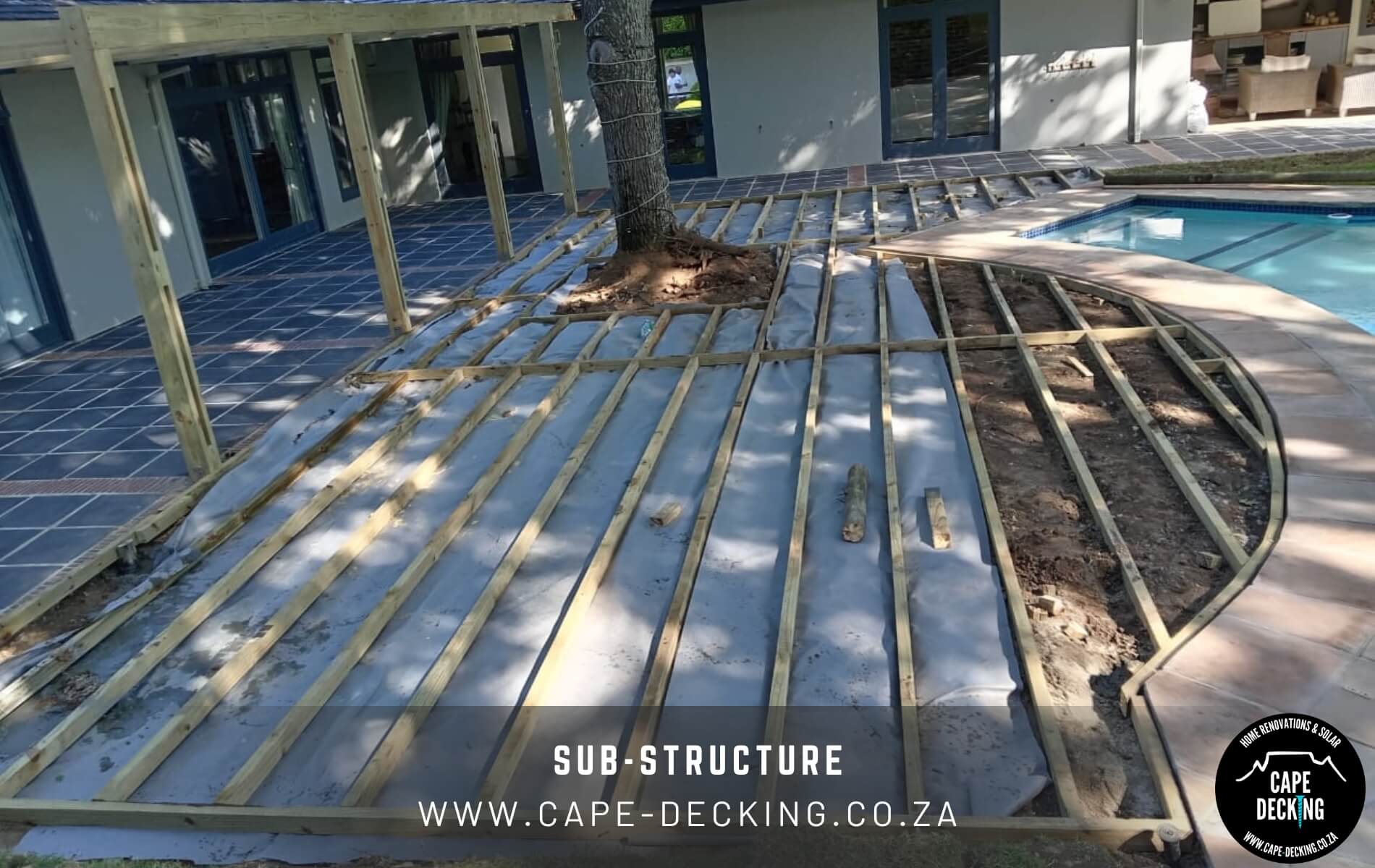
Substructure is a cost many homeowners overlook. The framework beneath your deck – typically treated timber or steel – adds R250 to R500 per m² to the total cost. This is not optional. A strong substructure determines how long your deck lasts.
Finishing and sealing protects the wood and extends the deck’s lifespan. Budget R3,500 to R10,000 for initial sealing depending on deck size, plus ongoing maintenance every 1 to 3 years depending on the wood type.
Municipal approvals and plans may be required depending on deck size, height, and location. If you need architectural drawings or an engineer’s report, this adds to upfront costs. Cape Decking can assist with plan submissions – ask us how it works when you request a quote.

Decking Costs Explained
Factors That Determine The Costs Of A Deck
- Choosing the cheapest quote rarely delivers the results you expect.
- Professional installers provide the right materials, machinery, transport, and experienced labour.
- These combined skills come at a premium – if you’re paying far less, something is missing, and the end product will suffer.
- Quality workmanship costs more, but it protects your investment and ensures a durable finish.
Decking Prices – What Effects The Cost Of A Deck
Read the full article here.
▪ Labour
One of the main costs is based on skilled artisans with knowledge on how to install a deck
▪ Materials
Choosing the right materials will determine the longevity of your end product.
 Equipment

You need the right tools to build a deck safely and accurately. Circular saws, drills, and sanding machinery help ensure a clean, professional result, while good materials improve strength and lifespan.
Other essentials include measuring tools, fastening tools, and post-hole digging equipment to create a solid foundation & sub-structure.
Types of Decking Wood Available in Cape Town
Choosing the right timber is the most important decision you’ll make. Here’s what’s commonly available and what each option offers.
Treated Pine is the most affordable solid timber decking option in Cape Town. It’s pressure-treated to resist moisture, insects, and fungal decay. Pine accepts stains and finishes well, allowing you to customise the look. With proper maintenance – resealing every 2 to 3 years – a treated pine deck can last 15 to 20 years. It’s an excellent choice for homeowners who want a quality deck on a tighter budget.
Garapa is a South American hardwood with a golden-yellow colour that deepens over time. It strikes an ideal balance between durability and affordability among the hardwoods. Garapa is naturally resistant to rot, insects, and weathering. It’s one of the most popular choices for wooden decking in Cape Town due to its lifespan of 25+ years and attractive grain.
Balau is a dense, heavy hardwood prized for its exceptional durability and rich reddish-brown tone. It’s highly resistant to moisture, insects, and general wear, making it ideal for high-traffic areas and pool surrounds. Balau requires pre-drilling during installation due to its density but rewards you with minimal maintenance and a lifespan of 25 to 30 years. It commands premium pricing but delivers premium performance.
Massaranduba (Brazilian Redwood) is one of the hardest and most durable decking timbers available. Its deep reddish-brown colour and fine grain make it a standout choice for homeowners wanting a truly premium deck. It performs exceptionally in Cape Town’s coastal climate, resisting both moisture and UV damage.
Pine Decking vs Hardwood Decking: Which Is Worth It?
This is the most common question we hear. The answer depends on your priorities and budget.
Pine decking costs roughly 40% to 50% less per m² than hardwood. It looks great when freshly installed and stained. The trade-off is maintenance – pine needs resealing every 2 to 3 years and is more susceptible to weathering, warping, and wear over time. If you maintain it well, it delivers solid value.
Hardwood decking (Balau, Garapa, Massaranduba) costs more upfront but requires less maintenance and lasts significantly longer. A hardwood deck typically needs oiling every 3 to 5 years rather than full resealing. Over a 20-year period, the total cost of ownership for hardwood is often comparable to pine once you factor in maintenance and potential replacement.
When to choose pine: – You have a defined budget and want maximum deck area for your money – You’re comfortable with regular maintenance – The deck is in a lower-traffic area
When to choose hardwood: – You want a long-lasting, low-maintenance deck – The deck is around a pool or in a high-traffic area – You value the natural beauty and colour depth of hardwood – You’re focused on long-term return on investment
Timber Decking vs Composite Decking: Cost Comparison
Composite decking is an alternative to natural timber, made from a blend of wood fibres and recycled plastic. It’s worth considering as part of your pricing research.
Composite decking ranges from R1,800 to R4,500 per m² installed. The higher-end products closely mimic natural timber grain and colour. The key advantage is near-zero maintenance – no staining, sealing, or oiling required. Most quality composite products carry warranties of 15 to 25 years.
Timber decking starts lower and offers the natural warmth and character that composite can’t fully replicate. Many homeowners prefer the feel and authenticity of real wood underfoot. Timber can also be sanded and refinished to look new again – composite cannot.
Cost over 15 years: – A 20 m² pine deck with regular maintenance: approximately R45,000 to R65,000 total – A 20 m² Balau deck with periodic oiling: approximately R60,000 to R80,000 total – A 20 m² mid-range composite deck: approximately R50,000 to R75,000 total
The right choice depends on your aesthetic preference, willingness to maintain, and long-term budget. Cape Decking installs both timber and composite – we’ll recommend the best fit for your project.
Pool Decking Prices in Cape Town
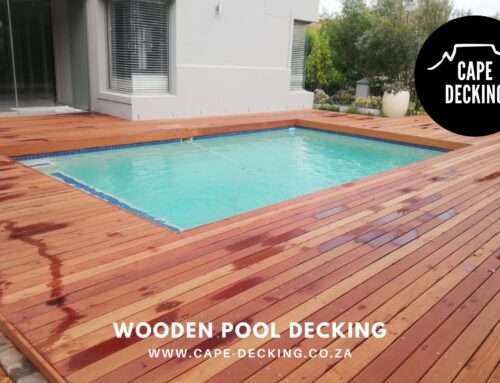
Pool areas are one of the most popular applications for timber decking. A well-built deck transforms the pool surrounds into a functional entertainment space while adding significant property value.
Pool decking prices follow the same per m² rates as standard decking, but pool installations often involve additional considerations:
- Slip resistance – hardwoods like Balau naturally offer better grip when wet compared to pine
- Moisture exposure – the deck sits adjacent to constant water, so timber selection and treatment are critical
- Drainage – proper board spacing and substructure design ensure water drains away efficiently
- Pool covers – if you want a sliding or fixed deck pool cover, this is a separate addition to the standard decking quote
Many Cape Town homeowners combine a pool deck with a wooden pergola overhead for shade and UV protection, creating a complete outdoor living area.
What Does a Decking Installation Include?
A professional timber decking installation in Cape Town typically follows these steps:
Step 1 – Site Assessment. A qualified installer visits your property to assess ground conditions, measure the area, check drainage, and discuss design options. This informs the final quote.
Step 2 – Design and Planning. Based on the site visit, the installer recommends timber type, substructure approach, and deck layout. If municipal plans are required, these are prepared for submission.
Step 3 – Substructure Construction. Concrete stumps or footings are installed, followed by the bearer and joist framework. This is the foundation of your deck and must be done correctly. ( Subject to each unique installation.)
Step 4 – Decking Board Installation. Boards are laid, spaced, and fastened. Hardwoods require pre-drilling. All cuts are sealed to prevent moisture ingress at exposed end grains.
Step 5 – Finishing. The deck is sanded if needed, cleaned, and sealed or oiled. Balustrades, stairs, or additional features are completed.
Step 6 – Final Inspection. The installer checks for level, structural integrity, drainage, and overall quality before handover.
A standard residential deck of 15 to 25 m² typically takes 3 to 7 days depending on complexity. Elevated or multi-level decks, or those requiring engineering, take longer.
If your property needs ground preparation before installation, this can be handled as part of a broader building and renovation project.
How to Avoid Cheap Decking That Costs You More
In decking, the cheapest quote is almost never the best value. Here’s what low-cost operators typically cut:
Timber quality. Thinner boards, lower-grade wood, or poorly treated pine that warps and splits within a few years.
Substructure shortcuts. Undersized joists, wider spacing between bearers, or untreated timber below the deck. The substructure is invisible once the deck is laid – but it determines everything about the deck’s longevity and safety.
Fasteners and hardware. Budget stainless steel or even galvanised screws that rust in Cape Town’s coastal air. Quality decking uses marine-grade stainless steel fasteners.
No compliance documentation. Professional installers provide compliance certificates and, where required, engineer-approved plans. Budget operators often skip this entirely.
No warranty. If the installer won’t warrant their workmanship, that tells you everything you need to know.
As covered in our decking prices per m² guide, paying more upfront for quality wood and experienced installers saves you significantly over the life of the deck.
Why Choose Cape Decking for Your Timber Deck
Cape Decking has been delivering quality outdoor timber solutions across Cape Town since 2015. We partner with experienced, certified installers and source only premium materials.
- Free quotes – no obligation, fully transparent pricing with detailed breakdowns
- Premium timber sourcing – Balau, Garapa, Massaranduba, and quality treated pine
- Experienced installers – professional teams who build to last, not just to finish fast
- Ongoing support – we’re here after installation for maintenance advice and follow-up
- Trusted by homeowners – check our customer reviews
We also install pool decking, composite decking, wooden pergolas, wooden fencing, and carports – everything you need to transform your outdoor space.
A treated pine deck lasts 15 to 20 years with regular maintenance (resealing every 2 to 3 years). Hardwood decks – Balau, Garapa, and Massaranduba – last 25 to 30 years with periodic oiling. Cape Town’s coastal climate demands quality timber and proper treatment to maximise lifespan. The substructure quality and installation workmanship are equally important. A well-built hardwood deck can outlast the home it’s attached to.
The best wood depends on your budget and priorities. For affordability, treated pine offers excellent value at R1,700 to R2,200 per m² installed. For durability and low maintenance, Balau and Garapa are the top choices in Cape Town – both resist moisture, insects, and weathering exceptionally well. Garapa offers a golden tone while Balau provides a richer reddish-brown colour. Read more about decking wood prices in South Africa and explore our wooden decking options.
Not necessarily. Entry-level composite decking starts around R1,800 per m² – similar to treated pine. Premium composite ranges up to R4,500 per m². The advantage of composite is near-zero maintenance, which can make it cheaper over 15 to 20 years. However, timber offers natural warmth, can be refinished, and often costs less upfront. Compare both options with our composite decking range or get a quote for both materials.
Timber decking prices in Cape Town range from R1,700 to R3,500 per m² fully installed in 2026. Treated pine sits at the lower end (R1,700 – R2,200 per m²), while premium hardwoods like Balau and Garapa range from R2,800 to R3,500 per m². These prices include materials, substructure, and labour. Extras like balustrades, stairs, and sealing are additional. Contact us for a free quote to get an accurate price for your property.
It depends on the size, height, and location of your deck. The City of Cape Town may require building plan submissions for elevated decks, large structures, or decks that affect boundary setbacks. Ground-level decks under a certain size may be exempt, but it’s always worth confirming. Cape Decking can handle plan submissions and council approvals on your behalf - just ask when you request your quote.




Share This Story, Choose Your Platform!
Related Posts


In this Article
RECENT BLOG POSTS
SEARCH THE SITE
TAGS