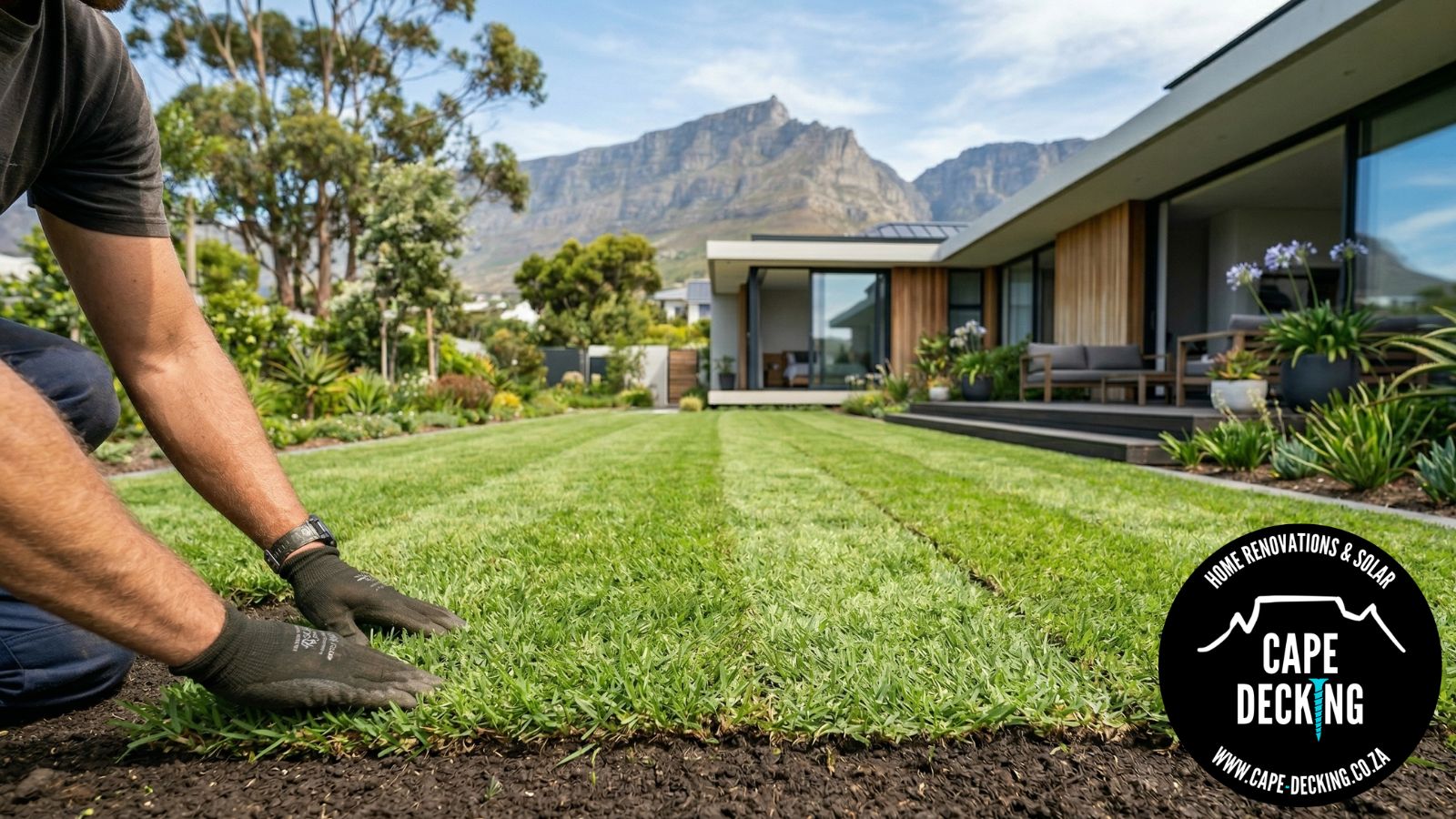
Kikuyu Grass: Why It Holds Up Better Than Almost Any Other Lawn in South Africa

Published On: April 16th, 2026|Views: 27|1368 words|
Kikuyu Grass Why It Holds Up Better Than Almost Any Other Lawn in South Africa - Kikuyu Grass - Roll on Lawn - Cape Decking

A Lawn That Actually Copes With South African Conditions

If you have ever tried to keep a lawn looking decent through a Cape Town summer, you will know it is not always easy. Water restrictions, baking heat, kids and dogs running around, and months without decent rain all take their toll. Most lawns struggle. Kikuyu, on the other hand, barely blinks.
It is not a coincidence that kikuyu lawn is the most widely used roll on lawn variety across South Africa. It has a genuine ability to cope with conditions that would leave other grasses brown and bare, and once it gets going, it pretty much takes care of itself. That combination of toughness and low fuss is exactly why so many Cape Town homeowners choose it when they are laying a new lawn or replacing an old one.
So what actually makes it so resilient? And is it the right roll on lawn for your garden? Read on.

A Bit of Background on Kikuyu Grass

Kikuyu grass (Pennisetum clandestinum) originally comes from the East African highlands, where it evolved to deal with warm temperatures, seasonal drought and nutrient-poor soils. It was introduced to South Africa in the early 1900s and adapted so well to local conditions that it is now found across the country, from domestic gardens to schools, sports fields and municipal parks.
As a roll on lawn, kikuyu is grown on specialist farms, harvested as pre-rooted rolls and delivered ready to lay. Within a matter of weeks of installation, it knits together into a dense, hard-wearing surface that requires relatively little attention to maintain. It is coarser than LM grass and spreads more aggressively than buffalo grass, but what it lacks in refinement it more than makes up for in sheer durability.

Kikuyu grass - roll on lawn - cape decking

Why Kikuyu Grass Is So Hardy

There are a few specific reasons why kikuyu performs so well in gardens that would wear other grasses down. It is not just tough in a general sense. It is built for the exact kind of challenges South African gardens throw at it.

Its Root System Goes Deep

Kikuyu roots push deeper into the soil than most other lawn varieties. That depth matters a great deal when summer arrives and the topsoil dries out quickly. While shallower-rooted grasses start to yellow and thin out, kikuyu is still drawing moisture from lower down. An established kikuyu lawn can stay looking green and full through conditions that would have a lesser grass on life support. For Cape Town gardens where summer watering is limited, that deep root system is a significant asset.

It Repairs Itself Quickly

Kikuyu spreads through both above-ground runners (stolons) and underground shoots (rhizomes). This dual approach means it can fill in worn or damaged patches at a pace that few other grasses match. If the kids wear a track in the lawn, or the dog digs around near the fence, kikuyu will cover it over within a few weeks without any input from you. That self-repairing ability is one of the most practical reasons families choose it as their roll on lawn of choice.

Heat Makes It Grow Faster, Not Slower

Most grass varieties slow down or go into survival mode when temperatures climb. Kikuyu does the opposite. It is what is known as a C4 plant, which means it has a particularly efficient way of processing sunlight into energy in hot, bright conditions. The hotter and sunnier it gets, the faster it grows. For gardens in the Western Cape that get long, dry summers with intense sun, this is exactly what you want from a roll on lawn.

It Handles Heavy Use Without Falling Apart

Kikuyu lawn has a dense, interlocking growth structure that holds up under consistent foot traffic better than most other roll on lawn varieties. This is why you see it on sports fields, school grounds and golf course rough around South Africa. It is not precious. You can use it hard and it will bounce back. If your garden gets a lot of activity, whether that is regular entertaining, children playing, or pets running around, kikuyu is well suited to that kind of life.

It Shades Out Weeds Naturally

A well-established kikuyu lawn grows thick enough that it shades the soil surface, making it difficult for weed seeds to take root. Combined with how quickly it spreads laterally, it tends to crowd out competition before weeds get a proper foothold. Over time this means less time pulling weeds by hand, fewer chemical treatments needed, and a generally tidier garden with less maintenance work. That is a benefit that only becomes more noticeable the longer the lawn has been down.

Low Water Needs Once It Is Settled In

Kikuyu does need regular watering during the first few weeks after your roll on lawn goes down. That establishment period is important. Once the roots are properly anchored though, it becomes noticeably more water efficient than many other lawn varieties. In a city like Cape Town where water restrictions are a regular part of summer life, having a lawn that can handle reduced irrigation without turning into a dust patch is genuinely useful. Plenty of homeowners here have found that kikuyu holds its colour and density well into periods when other grass types have already given up.

Kikuyu grass - roll on lawn - cape decking 2

How Does Kikuyu Compare to LM Grass and Buffalo Grass?

Kikuyu is not the only roll on lawn option available, and it is worth being honest about what it is good at and where other varieties might suit your garden better.

Feature Kikuyu Lawn LM Grass Buffalo Grass
Sun Requirement Full sun Semi-shade OK Full sun / light shade
Drought Tolerance Excellent Moderate Very good
Foot Traffic Excellent Moderate Good
Growth Speed Very fast Moderate Slow to moderate
Maintenance Medium (frequent mow) Low Low
Water Use Low to moderate Moderate Low
Best For Active families, sports Shaded gardens Water-wise gardens

LM grass is a softer, finer-leaved variety that suits gardens with partial shade or tree cover. It needs less mowing and feels nicer underfoot, but it does not hold up as well under heavy use and does not cope as well with drought. If your garden has decent shade and sees lighter traffic, LM grass is worth considering.

Buffalo grass is a broader-bladed, slower-growing variety with good drought resistance and reasonable shade tolerance. It does not spread as aggressively as kikuyu, which means it is less likely to creep into your garden beds. For homeowners who prioritise low water use and minimal maintenance, buffalo grass is a solid choice. It just will not recover as quickly from heavy wear.

Kikuyu sits at the more demanding end of the maintenance scale because it grows fast and needs regular mowing. But if you want a lawn that survives drought, handles traffic and repairs itself when it takes a knock, it is genuinely hard to beat as a roll on lawn option in South Africa.

Getting Your Kikuyu Lawn Off to a Good Start

A few simple steps after installation will set your roll on lawn up properly:

  • Water deeply every second day for the first two to three weeks. The rolls need to root down and dry soil will slow that process significantly.
  • Wait until the grass reaches around 5 to 6 cm before you mow for the first time. Cutting too early puts the roots under unnecessary stress.
  • Put down a slow-release lawn fertiliser in spring to give the grass a proper boost as growing season kicks in.
  • Edge the lawn every few weeks to keep it out of your garden beds. Kikuyu is a spreader and will take any opportunity to creep into areas you do not want it.
  • Once established, pull back on the watering gradually. Kikuyu does not need nearly as much water as most people assume once its root system is properly settled.

If you are ready to put down a new lawn, take a look at our roll on lawn options at Cape Decking. We supply and install kikuyu lawn, LM grass and buffalo grass across Cape Town, and we are happy to help you work out which variety suits your garden best.

custom logowww.cape-decking.co.zawww.cape-decking.co.za
4.7 Stars - Based on 114 User Reviews
facebook logogoogle logologo
Complete the below form to get a call back from one of our team members and to schedule an appointment.
What is Kikuyu Grass?2026-04-17T03:18:09+00:00

What Is Kikuyu Lawn & Kikuyu Grass Advantages

  • Kikuyu grass is a fast-growing, warm-season lawn grass widely used across South Africa, particularly in sunny regions like Cape Town. It is easily recognised by its bright green colour, coarse texture, and vigorous growth habit, spreading rapidly through runners to form a dense lawn.
  • One of Kikuyu’s biggest advantages is how quickly it establishes. It’s often used in new gardens or landscaping projects where fast ground coverage is needed. Once established, it becomes relatively drought-tolerant, making it well-suited to Cape Town’s dry summers and water restrictions.
  • Kikuyu lawn performs best in full sun and struggles in heavily shaded areas. It is also highly resilient to foot traffic, which makes it a popular choice for family gardens, outdoor spaces, and areas that see regular use. However, its aggressive growth can also be a drawback.
  • Without regular mowing and edging, Kikuyu can spread into flower beds, paving, and other landscaped areas. It requires consistent maintenance to keep it neat and under control. Overall, Kikuyu grass roll on lawn is ideal if you’re looking for a hardy, affordable, and fast-establishing lawn that thrives in sun and can handle wear and tear unlike Buffalo Grass & LM Berea Grass

Contact us for a quotation.

What is Buffalo Grass?2026-04-17T03:04:14+00:00

Buffalo Lawn Explained

Buffalo grass is a popular lawn grass known for its broad, soft leaves and excellent shade tolerance, making it a preferred option for gardens that don’t receive full sun throughout the day. It forms a thick, carpet-like lawn that feels comfortable underfoot, which is why it’s often chosen for residential spaces.

Unlike faster-growing grasses like Kikuyu Grass roll on lawn, Kikuyu VS Buffalo grass – Buffalo grass grows more slowly and in a more controlled manner. This makes it significantly easier to maintain, as it requires less frequent mowing and edging. It’s also less invasive, meaning it won’t aggressively spread into surrounding garden beds.

Buffalo grass performs well in both sun and partial shade, although it truly stands out in shaded areas where other grasses may thin out or struggle. It also has moderate water requirements and can retain its lush appearance with less frequent watering compared to some other lawn types.

Because of its soft texture and dense growth, Buffalo grass is ideal for families with children and pets. However, it is slightly less tolerant of heavy foot traffic compared to Kikuyu and may take longer to recover from wear.

Overall, Buffalo grass is best suited for homeowners looking for a low-maintenance, visually appealing lawn that performs well in shade and provides a soft, comfortable surface. If you are looking for Buffalo grass comparison to LM Berea Grass, click this article here.

Contact us for a quotation.

What is LM Berea Grass?2026-04-17T03:10:43+00:00

LM Berea Grass Explained

LM Berea grass is a fine-textured, evergreen lawn grass known for its neat appearance, slow growth, and excellent shade tolerance. It is one of the most versatile lawn options in South Africa, performing well in both sunny and shaded areas. This grass type forms a dense, uniform lawn with a softer, more refined look compared to coarser grasses like Kikuyu. Because it grows more slowly, LM Berea requires less frequent mowing, making it a popular choice for homeowners seeking a low-maintenance garden solution.

LM Berea also retains moisture well, which helps it stay greener for longer with moderate watering. This makes it a practical option in regions like Cape Town, where water conservation is often a priority. One of its standout features is its ability to thrive in shaded environments, making it ideal for gardens with trees, walls, or buildings that limit direct sunlight.

However, it is less tolerant of heavy foot traffic and may not be the best choice for high-use areas like play spaces. Worth reading about the comparisons between LM Grass, Kikuyu vs Buffalo Grass. Overall, LM Berea grass is best suited for homeowners who want a tidy, evergreen lawn that requires minimal upkeep and performs well in both sun and shade.

Contact us for a quotation.

How do I prepare my garden before the roll on lawn is planted?2026-04-17T03:17:26+00:00

Pre Installation Roll On Lawn Preparation Work

Good preparation is what separates a lawn that takes well from one that struggles in the first few months. Start by removing all existing weeds, grass, stones and debris from the area. We do this for you! Weeds left in the soil will push through your new lawn, so it is worth taking the time to do this properly rather than rushing it.

Once the area is clear, level the soil and add a 50 to 100 mm layer of good-quality topsoil or compost. We supply compost as an additional offering but is a must for your lawn to root down and get the required nutrients. In very sandy area’s this base layer should be 100-200 mm thick. We do this for you!

This improves drainage, yet at the same time retains moisture, adds nutrients and gives your roll on lawn the best possible base to root into. Lightly water the prepared bed before you lay the rolls, and make sure each roll is pushed firmly against the last with no gaps between them.

Water thoroughly straight after installation and keep the soil moist for the first two to three weeks while the roots are establishing. After that, you can ease off gradually as the lawn settles in.

If you live in an area with sandy soil such as Hout Bay where there is a lot of dune / beach sand, you will require an even thicker base layer or your lawn with dry out, in summer it will bake from the top and the bottom and kill your lawn if the base layer is not thick enough to retain moisture. We have a solution.

Compost depth, coir fibre, and bentonite clay – the three-layer solution for Cape coastal gardens losing water straight into the dunes. Read more about this in our article “How to Build a Lawn That Survives on Sand?”

Cape Decking teams supply and install Kikuyu Grass, LM Grass and Buffalo Grass across Cape Town. If you would like a quote or discuss what grass variety suits your space, read our comparisons between kikuyu vs buffalo grass or other grass FAQ’s here or get in touch via the link below.

Find out more and get a quote for roll on lawn installation

Kikuyu vs buffalo grass: what is the actual difference2026-04-17T03:12:27+00:00

Kikuyu vs Buffalo Grass Explained

These two varieties get compared a lot, and they do overlap in some ways. Both cope reasonably well with South African conditions, but they suit different types of gardens.

Kikuyu lawn grows fast, spreads aggressively and handles heavy foot traffic without much trouble. It is the better option for gardens with children, dogs, or outdoor areas that see regular use. The tradeoff is that it needs more frequent mowing and it will try to spread into your flower beds if you are not keeping on top of edging.

Buffalo grass is a broader-bladed, slower-growing grass that uses less water and needs less maintenance than kikuyu. It handles some shade and is less likely to invade surrounding beds because it does not spread as energetically. For water-conscious homeowners, or for gardens that do not see heavy traffic, buffalo grass is a very practical choice.

If durability and fast recovery matter most, go kikuyu. If water savings and low maintenance are your priority, buffalo grass is worth a serious look. If you are looking for the comparison between Kikuyu vs LM grass, find out more here.

See all roll on lawn options here.

Kikuyu vs LM grass: which one should I go with?2026-04-17T03:14:09+00:00

Kikuyu vs LM grass

The honest answer depends on your garden. If you have a sunny, open space that gets a lot of use, kikuyu lawn is probably the better choice.

Kikuyu Grass grows fast, spreads quickly and bounces back from wear in a way that LM grass simply cannot match. It does grow faster though, which means you will be mowing more often during the growing season.

LM Grass suits gardens that have trees, structures or fencing that creates shade for part of the day. It has a finer leaf and a softer texture than kikuyu, and it grows more slowly, so the maintenance load is lower. If your garden is relatively sheltered and not subject to heavy traffic, LM grass will give you a neater, lower-maintenance surface.

The short version: kikuyu wins on toughness and recovery, LM grass wins on texture and low maintenance. Your garden conditions will tell you which matters more. Find out more about Buffalo Grass as an option and the difference between Kikuyu vs buffalo grass here.

View our roll on lawn range here.

Published On: April 16th, 2026Categories: Roll On Lawn

Share This Story, Choose Your Platform!

Related Posts

In this Article

RECENT BLOG POSTS

SEARCH THE SITE

TAGS

Categories

Go to Top